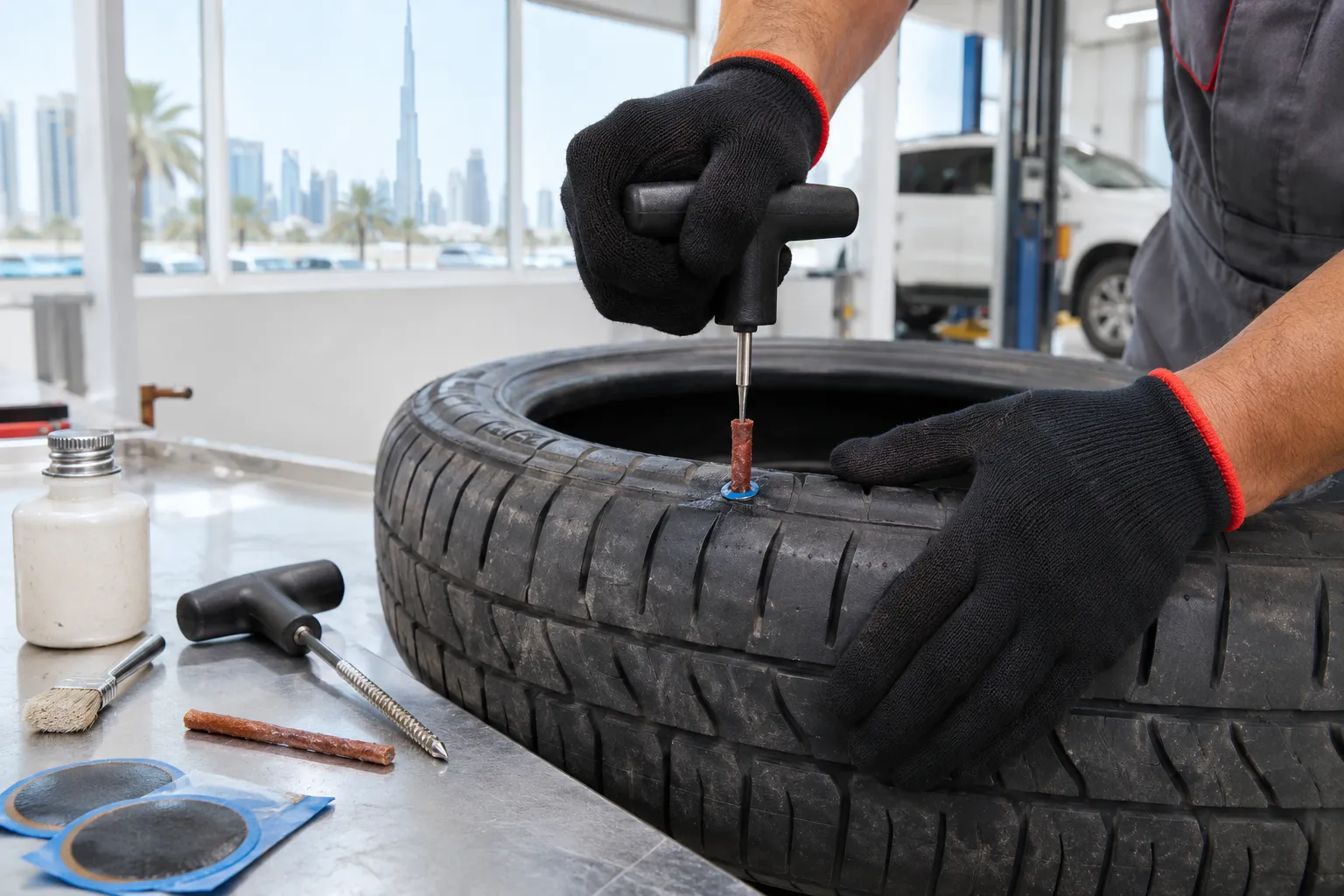
Yes, most punctured tyres can be repaired, as long as the hole is in the central tread area, is no wider than about 6 mm, and the tyre wasn't driven far while flat. A puncture in the shoulder or sidewall, a cut longer than that, or damage to the inner liner from running flat means the tyre has to be replaced.
I get asked this almost every day, usually by someone holding a phone photo of a screw in their tread. The honest answer always comes after the tyre is off the rim. Here's what I'm looking for and why.
The three questions that decide whether a puncture is repairable
Every repair decision comes down to where the damage is, how big it is, and what happened to the tyre after it lost air. Tyre makers and the US Tire Manufacturers Association set out the same basic limits, and a good workshop follows them every time rather than judging by eye from the outside.
| Question | Repairable | Not repairable |
|---|---|---|
| Where is the hole? | Central tread (the crown), away from the shoulders | Shoulder, sidewall, or angled into the shoulder |
| How big is it? | Up to about 6 mm (¼ inch) across | Larger holes, long cuts or tears |
| Was it driven flat? | Stopped quickly, liner smooth inside | Rubbed liner, grey dust, creased sidewall |
| Earlier repairs? | Separate from any old repair | Overlapping an earlier repair |
Why sidewall punctures cannot be fixed
The sidewall bends every time the wheel turns, and in UAE summer it does that while it's very hot. A patch bonded to the inside of the sidewall can't follow that movement for long, so it lifts, the cords underneath start to fail, and the tyre can let go at motorway speed. That's why no tyre maker approves sidewall repairs, whatever a roadside kit claims.
The shoulder is a grey area for drivers but not for technicians: if any part of the damage reaches it, the answer is a new tyre. You can see examples on our page about sidewall cuts and damage.
What a proper repair looks like
A correct puncture repair is done from the inside, with the tyre taken off the rim. A string plug pushed in from outside, the kind sold at petrol stations, seals the hole but leaves the inside unchecked, so it should be treated as a temporary fix to get you home.
- Demount and inspectThe tyre comes off the rim so we can see the inner liner and check the object didn’t travel at an angle into the shoulder.
- Clean the injuryThe hole is drilled clean along the path the object took, which removes damaged steel and rubber.
- Plug-patch from insideA combined plug-and-patch fills the hole and seals the liner in one piece. A plug alone or a patch alone is not an approved repair.
- Refit, balance, leak testThe tyre goes back on, gets balanced, is inflated to the placard pressure and checked for leaks.
That's the method we use for every puncture repair, at the kerb or in the workshop.
Driving on it decides more than the nail does
A typical case we see is a small screw in the centre of the tread, which would be an easy repair, except the tyre was driven a few kilometres to a petrol station while almost flat. Inside, the liner is scuffed into a grey powder and there's a ring where the sidewall folded. That tyre is finished, and the screw had nothing to do with it.
If you're stuck at the roadside, our flat tyre service comes to you. That's usually cheaper than the tyre you'd ruin trying to reach a workshop.
Run-flats, slow leaks and other special cases
- Run-flat tyres: many makers advise against repairing them at all, because the stiff sidewall hides internal damage. Read can run-flat tyres be repaired before you decide.
- Slow leaks with no visible nail: often a leaking valve, a corroded rim bead or a tiny piece of wire. A dunk test or soapy water usually finds it, and many are fixable without a patch.
- Two punctures close together: each repair must sit on its own. Patches that overlap mean the tyre is replaced.
- Tyres near five years old: we can repair them, but if the DOT date shows the tyre is close to its UAE age limit, a new tyre may be the better spend.
Send us a photo of the puncture and the tyre sidewall on WhatsApp, and we’ll tell you if it looks repairable before we come out.
Questions drivers ask
How big a hole in a tyre can be repaired?
Up to about 6 mm (¼ inch) in diameter, in the central tread. Larger holes, cuts and tears are not repairable even if a plug would seal them. The limit comes from tyre maker and USTMA repair procedures.
Can a tyre be repaired twice?
Yes, as long as each repair is in the tread area and the patches do not overlap. The tyre also has to be in good condition otherwise, with enough tread and no age or heat damage. We check the earlier repair while the tyre is off the rim.
Is a plug from a petrol station safe?
It is a temporary fix. A string plug seals the hole from outside but nobody has checked the inside of the tyre. Have it replaced with a plug-patch repair from inside within a few days.
Can a nail near the edge of the tread be repaired?
Only if the whole injury, including the angle the nail travelled, stays out of the shoulder. Nails often go in at an angle, so we only decide once the tyre is off the rim and we can see where it came through.
Should I pull the nail out myself?
No. Leave it in. It is often plugging the hole, and pulling it can turn a slow leak into a flat. Keep the pressure topped up and book a repair.