No tyre is best at everything. The rubber compound and tread pattern that give a tyre short wet braking distances tend to cost tread life or fuel economy, and a tyre built to last 80,000 km rarely grips like a sports tyre. Choosing well means deciding which two or three qualities matter most for how you drive.
For most UAE drivers those are dry grip and stability at highway speed, a tyre that tolerates heat, low road noise on long commutes, and a sensible wear rate. Wet grip matters for the few days a year when it rains and the road surface turns slick.
The trade-off in one picture
The EU’s tyre labelling regulation states the link directly: improving rolling resistance can harm wet grip, and improving wet grip can increase external rolling noise. Tyre makers move the whole shape outwards with better compounds and engineering, which is part of why a premium tyre costs more. They still cannot escape the trade-off.
Dry grip and braking in the heat
Dry grip comes from a soft, sticky compound and stiff tread blocks that do not squirm under load. Performance tyres maximise both, which is why they feel planted on a fast motorway curve. The catch in the UAE is heat: very soft compounds wear quickly on surfaces that bake in the summer sun, and a cheap tyre that feels fine in April can feel greasy in August.
Braking distance is the number to care about. Make sure any tyre you consider carries the load index and speed rating your car maker specifies, so it is designed for the heat and load of your car. Our tyre size guide shows where those markings are.
Wet grip: rare in the UAE, but it is when accidents happen
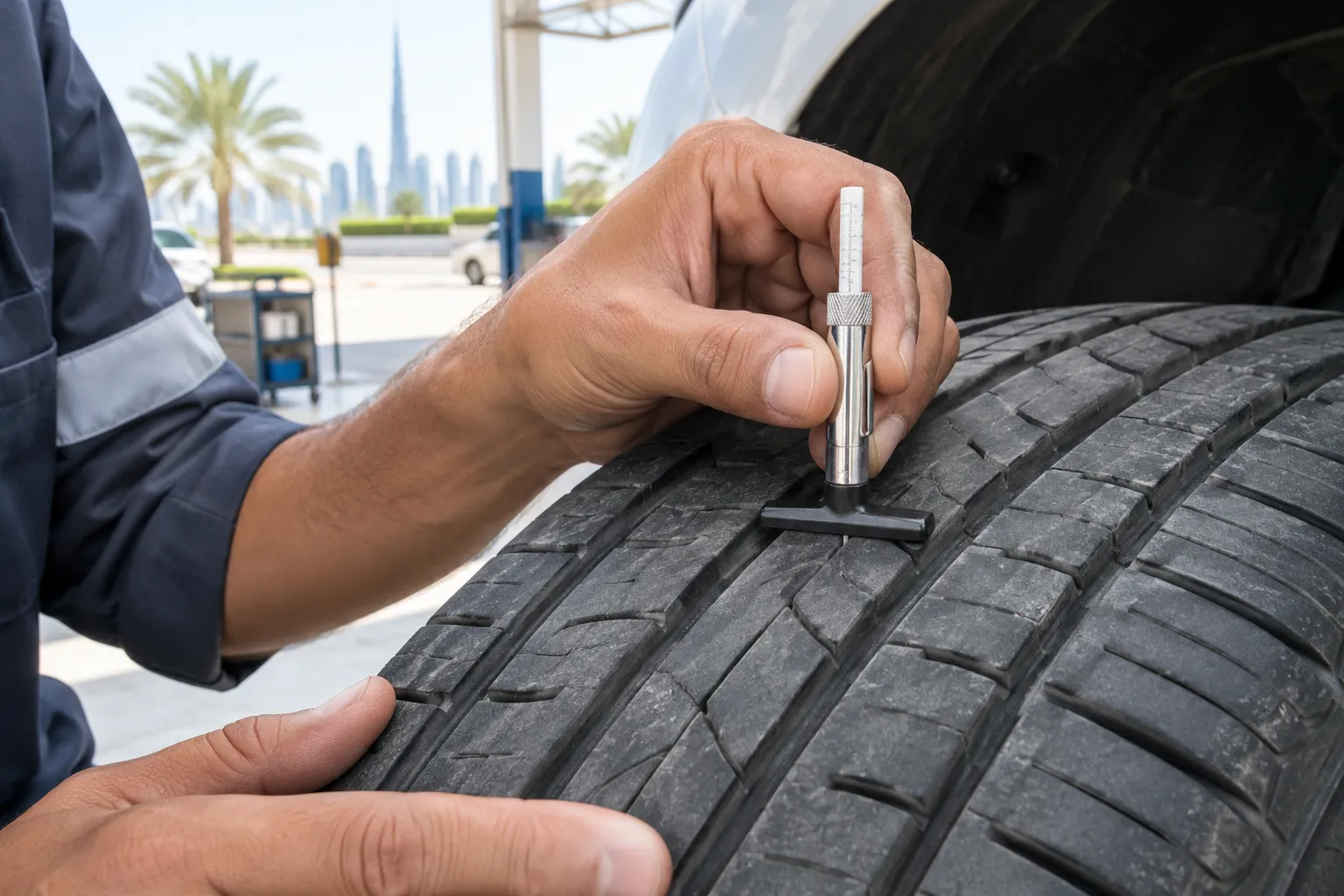
Rain is infrequent here, which makes the first showers dangerous: months of oil, rubber dust and sand sit on the road surface and turn slick when wet. Wet grip depends on tread depth and on grooves and sipes that move water out of the contact patch. That is why it falls away as a tyre wears, and why checking tread depth matters even in a dry climate.
Noise and comfort on long commutes
Road noise comes from air pumping through the tread and from the tyre vibrating on the surface. Touring tyres use varied tread-block shapes and softer sidewalls to break up the hum, while performance and off-road treads trade quietness for grip. The EU label rates external noise in decibels with an A, B or C class. Cabin noise also depends on the car and the road surface.
Comfort comes mostly from sidewall height. A 65-profile tyre absorbs speed bumps and expansion joints far better than a 35-profile one, so if your car offers two wheel sizes, the smaller rim is the comfortable choice. Our page on touring tyres covers tyres built for this.
Tread life and the UTQG treadwear number
Many tyres sold in the UAE carry a US UTQG marking such as “TREADWEAR 400 TRACTION A TEMPERATURE A”. The treadwear figure is relative: a 400 tyre should last about twice as long as a 200 under the same test conditions. It is assigned by the manufacturer, so it is most reliable when comparing tyres from the same brand.
| UTQG grade | What it measures | How to use it |
|---|---|---|
| Treadwear (e.g. 300, 500) | Relative wear rate in a standard test | Higher means slower wear. Compare within one brand. |
| Traction (AA, A, B, C) | Straight-line braking on wet surfaces | AA and A are the ones to look for. |
| Temperature (A, B, C) | Resistance to heat build-up at speed | A is best: a sensible minimum for UAE summers. |
In the UAE, tyres are usually replaced five years after their manufacture date, so a very long-wearing tyre on a low-mileage car can age out before its tread wears out. Our article on how long tyres last in the UAE explains both limits.
Rolling resistance and fuel economy
Rolling resistance is the energy a tyre wastes as it flexes. Lower is better for fuel economy and for EV range, which is why EV tyres and hybrid tyres prioritise it. The EU label grades it from A to E. The trade-off is that very low rolling resistance compounds can give up some wet grip, so look for a tyre with good ratings on both rather than chasing one letter.
Under-inflation increases rolling resistance immediately. The simplest economy upgrade costs nothing: keep the tyres at the placard pressure. See our tyre pressure guide.
Three practical examples
Daily Dubai commuter sedan
- Priorities: quietness, wet braking, wear
- Good match: a touring tyre with a decent treadwear grade
- Skip: soft performance compounds that wear fast in heat
Weekend sports coupe
- Priorities: dry grip, braking, steering response
- Good match: a performance tyre at the specified speed rating
- Accept: more noise and a shorter tread life
Family SUV with desert trips
- Priorities: load capacity, sidewall strength, sand traction
- Good match: highway-terrain or all-terrain, depending on how often you go off road
- Accept: more hum and slightly higher fuel use
Tell us how you drive and we will suggest two or three tyres in your size.
Questions drivers ask
Which matters more in the UAE, wet grip or dry grip?
Dry grip and heat tolerance matter on most days, but wet braking matters most on the few days it rains, when roads are slick with oil and sand. A good all-round tyre should score well on both. Do not give up wet grip entirely just because it rarely rains.
What does UTQG treadwear 400 mean?
It means the tyre wore about four times more slowly than a reference tyre in a standard US test. Treat it as a relative comparison, most useful within one brand, not as a mileage promise.
Are quiet tyres less grippy?
Not necessarily, but there is a trade-off. Features that reduce noise, such as smaller and more varied tread blocks, can soften steering feel, and aggressive treads that grip in sand or mud are noisier on tarmac. Premium touring tyres manage both reasonably well.
Do low rolling resistance tyres save fuel?
Yes. Rolling resistance is part of what the engine or battery has to overcome, so a lower figure reduces consumption. The saving depends on the car and driving style, and keeping pressures correct matters just as much.