The right tyre pressure for your car is the cold pressure printed on the placard on the driver’s door frame, inside the fuel flap or in the handbook. It is not the number moulded on the tyre’s sidewall, which is the tyre’s maximum. Set the pressure when the tyres are cold, and use the higher full-load figure when the car is packed or towing.
In the UAE, heat makes pressure readings move more than in cooler countries, so when and where you check matters almost as much as the number itself.
Where is the recommended tyre pressure for my car?
Car makers print the recommended pressures on a label, usually on the driver’s door pillar, sometimes inside the fuel flap or the glovebox. The handbook repeats them, often with extra lines for different tyre sizes, so check you are reading the row for the size actually fitted. Our tyre size guide shows how to read that size off the sidewall.
PSI, kPa and bar: reading the units
Pressure gauges and placards in the UAE show any of three units. They measure the same thing, so convert rather than guess. 1 bar is 100 kPa, which is about 14.5 PSI.
| PSI | kPa | bar |
|---|---|---|
| 30 | 207 | 2.1 |
| 32 | 221 | 2.2 |
| 33 | 228 | 2.3 |
| 35 | 241 | 2.4 |
| 36 | 248 | 2.5 |
| 38 | 262 | 2.6 |
| 42 | 290 | 2.9 |
Petrol-station air machines in the UAE mostly show PSI, while many European cars show kPa or bar on the placard and on the TPMS screen. If the screen and the machine disagree by about a factor of 14, one is in bar and the other in PSI.
Why you check tyres cold, and what heat does
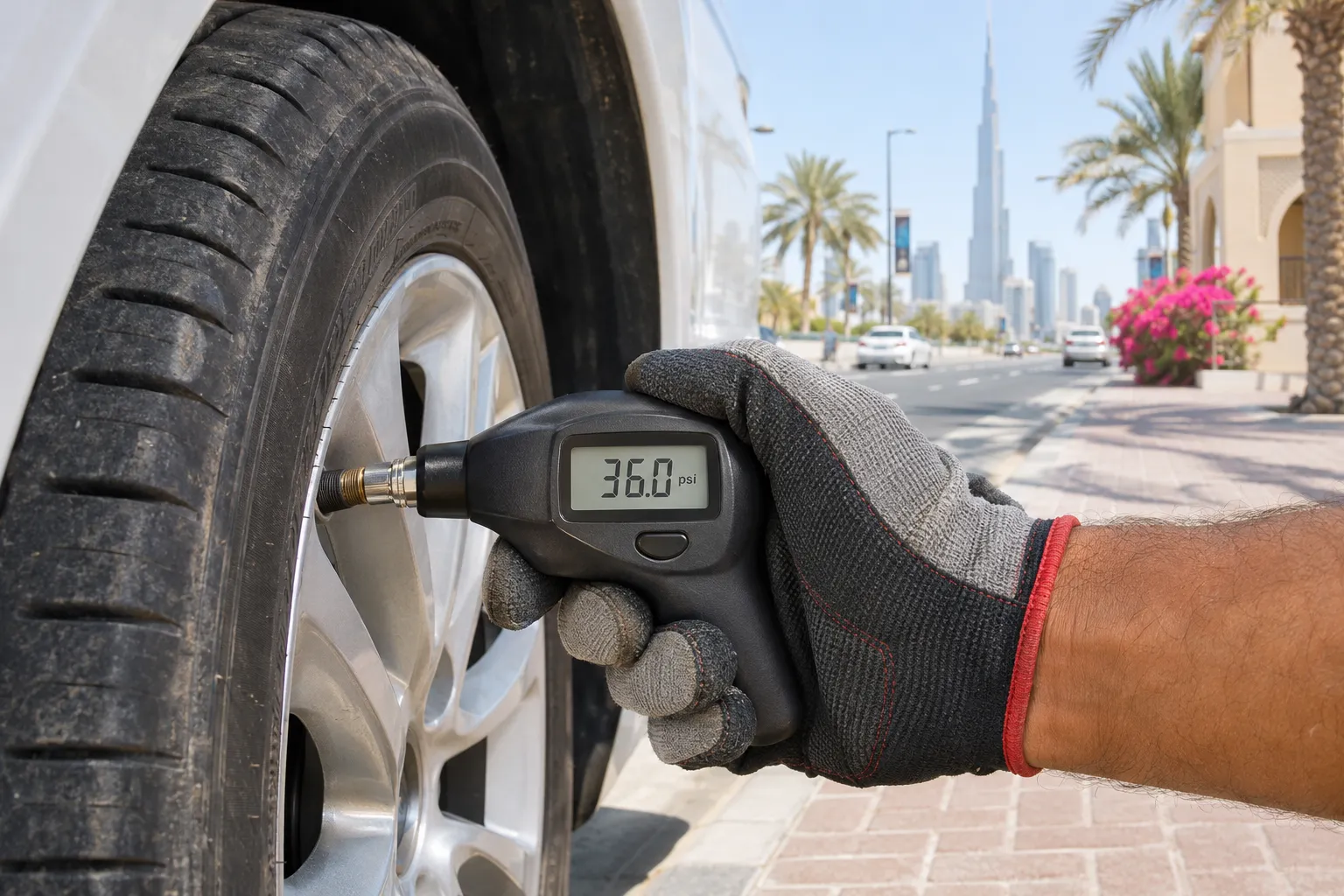
Air expands as it warms, so a tyre that has just come off Sheikh Zayed Road, or has been parked in the afternoon sun, reads higher than the same tyre at dawn. The placard figure is a cold figure: the car has been parked for a few hours out of direct sun, or has only been driven a short distance.
- Check early or in the shadeFirst thing in the morning, or in a basement car park, gives the truest cold reading.
- Never let air out of a hot tyreA high reading after a drive is normal. Releasing air then leaves the tyre under-inflated once it cools.
- If you can only check warmNote the reading and recheck cold the next day before you adjust anything downwards.
Under-inflation is the more dangerous mistake in hot weather. A soft tyre flexes more, builds more heat and is the classic starting point for the failures we describe in tyre blowouts in a UAE summer.
Load, passengers and towing
Most placards give two sets of figures: one for normal driving and a higher one for a full load of passengers and luggage, or for towing. Use the full-load figure before a long trip with the car packed, or when pulling a boat or a camping trailer, then return to the normal figure afterwards.
Front and rear figures often differ, especially on front-wheel-drive cars with heavy engines. Set each axle to its own number. An XL tyre can need a different pressure from a standard-load tyre in the same size, so tell us if you have changed tyre type.
What a TPMS warning means
A tyre pressure monitoring system (TPMS) warns you when a tyre has lost a significant amount of pressure. Under the US rule that many systems are designed to, the light must come on when a tyre is 25% or more below the recommended cold pressure. By then the tyre is already well under-inflated, so TPMS is a backstop, not a replacement for checking.
Steady light
- One or more tyres are low
- Check all four and the spare, cold if possible
- If one keeps dropping, suspect a puncture
Flashing, then steady
- Usually a system fault
- A sensor battery, a damaged sensor or one not paired
- Pressure may be fine, but the system cannot see it
If the light keeps coming back, read our guide to the tyre pressure warning light, or book a TPMS sensor check. We read each sensor with a diagnostic tool and tell you whether it is a leak, a dead sensor or a pairing issue.
Desert driving is the one time you go below the placard
Lowering pressure for sand is a deliberate, temporary exception, and the figure depends on the car, the tyre and the dunes. Drive slowly while deflated, and reinflate to the placard figure before the tarmac. Our article on desert driving tyre pressure walks through the routine.
Want all four tyres and the spare checked and set to your placard?
Questions drivers ask
What should my tyre pressure be?
Use the cold pressure on your car’s placard, usually on the driver’s door frame, or in the handbook. It is specific to your car and tyre size. Do not use the maximum figure on the tyre sidewall.
Is 40 PSI too high for my car tyres?
For most cars, 40 PSI is above the normal placard figure, but some cars and XL tyres do specify pressures around there, especially at full load. Compare it with your placard. If 40 PSI is a hot reading after a drive, it may be correct once the tyre cools.
Should I check tyre pressure hot or cold?
Cold. The recommended figures are cold pressures, so check before driving or after the car has been parked for a few hours in the shade. Never release air from a hot tyre to match the placard.
How often should I check tyre pressure in the UAE?
At least once a month and before every long drive, plus whenever the season changes sharply. A tyre can lose pressure slowly without a puncture. Check the spare too, since it is the one you need when another tyre fails.
Does the TPMS light mean I have a puncture?
Not necessarily. It means at least one tyre is low, or, if it flashed first, that the system has a fault. Check all four tyres, and if one keeps losing pressure, have it inspected for a puncture.