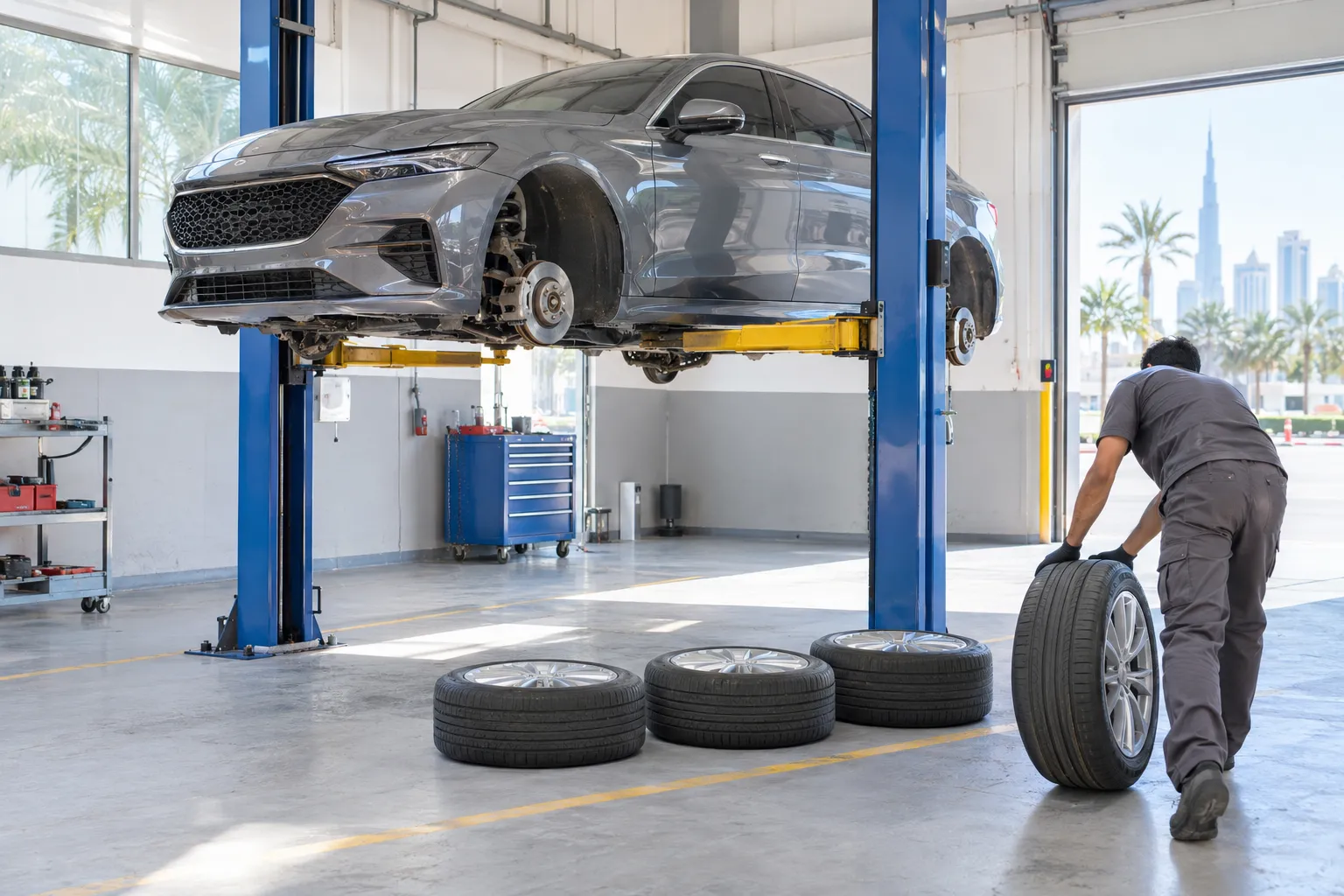
Tyre rotation moves each tyre to a different position on the car so that all four wear at the same rate. Front tyres on front-wheel-drive cars, which covers most sedans and crossovers in Dubai, wear noticeably faster than the rears. TireFix rotates tyres at your home or office in Dubai, Sharjah and Abu Dhabi, using the pattern your car and tyres need.
When you need it
- Your handbook's rotation interval is due
- If there is no interval, roughly every 8,000 to 10,000 km
- The front tyres have clearly less tread than the rears
- Before a long road trip, to even out tyres ahead of new ones
What the technician checks
- Tread depth on all four before rotating
- Whether tyres are directional or staggered (different sizes front and rear)
- Uneven wear that points to an alignment problem
- Pressures set for each new position
- Wheel nut torque
What the starting price covers
- Rotating all four wheels in the right pattern
- Tread depth readings for each tyre
- Pressures set to the placard
- Wheel nuts torqued
What can change the final price
- Adding wheel balancing in the same visit
- Directional tyres that need to be dismounted to swap sides
- Locking wheel nuts without the key
Where the work is done
Rotation only needs the car lifted safely, so we do it at your location as well as at the workshops.
Workshops: Al Quoz workshop (Dubai), Sharjah workshop (Sharjah), Mussafah workshop (Abu Dhabi).
Which rotation pattern your car needs
| Car or tyre | Pattern |
|---|---|
| Front-wheel drive (most sedans and crossovers) | Forward cross: fronts straight back, rears cross to the front |
| Rear-wheel drive or 4x4 | Rearward cross: rears straight forward, fronts cross to the back |
| Directional tyres | Front to rear on the same side only |
| Staggered sizes front and rear | Side to side only if the tyres are non-directional; often cannot be rotated |
Why rotation saves money
If you never rotate, the front pair on a front-wheel-drive car can wear out well before the rears. You then replace two tyres while the others still have life, and the car runs with mismatched tread for a while. Rotating keeps the set even so you replace all four together, at the right time.
Bridgestone recommends following the vehicle maker's schedule, or rotating roughly every 8,000 km when there is none. Our care guide on when to rotate your tyres explains how to fit that into UAE driving.
Rotation is a good moment to check for other problems
With the wheels off, we look closely at the tread. Wear on one shoulder points to wheel alignment, wear in the centre to overinflation, and patchy scalloping to balance or suspension. Rotating a tyre with an alignment problem only spreads the damage around.
Book a rotation and wear check at your parking spot.
Questions drivers ask
How often should I rotate my tyres?
Follow your handbook. If it does not say, around every 8,000 to 10,000 km, or at every oil service, is a sensible routine. See when to rotate your tyres.
Can all tyres be rotated?
Most can. Directional tyres only move front to rear on the same side, and cars with different sizes front and rear often cannot rotate between axles at all.
Does rotation need balancing?
Not always, because the tyres stay on their rims. If you feel a vibration after rotation, a wheel that was fine at the back may be out of balance at the front, so we can add wheel balancing.
Should I rotate a new tyre to the back?
When you only buy two, the better tyres usually go on the rear for stability. See new tyres: front or back.
Do I need a workshop for rotation?
No. We lift the car safely at your location, rotate the wheels, check pressures and torque the nuts, all from the van.