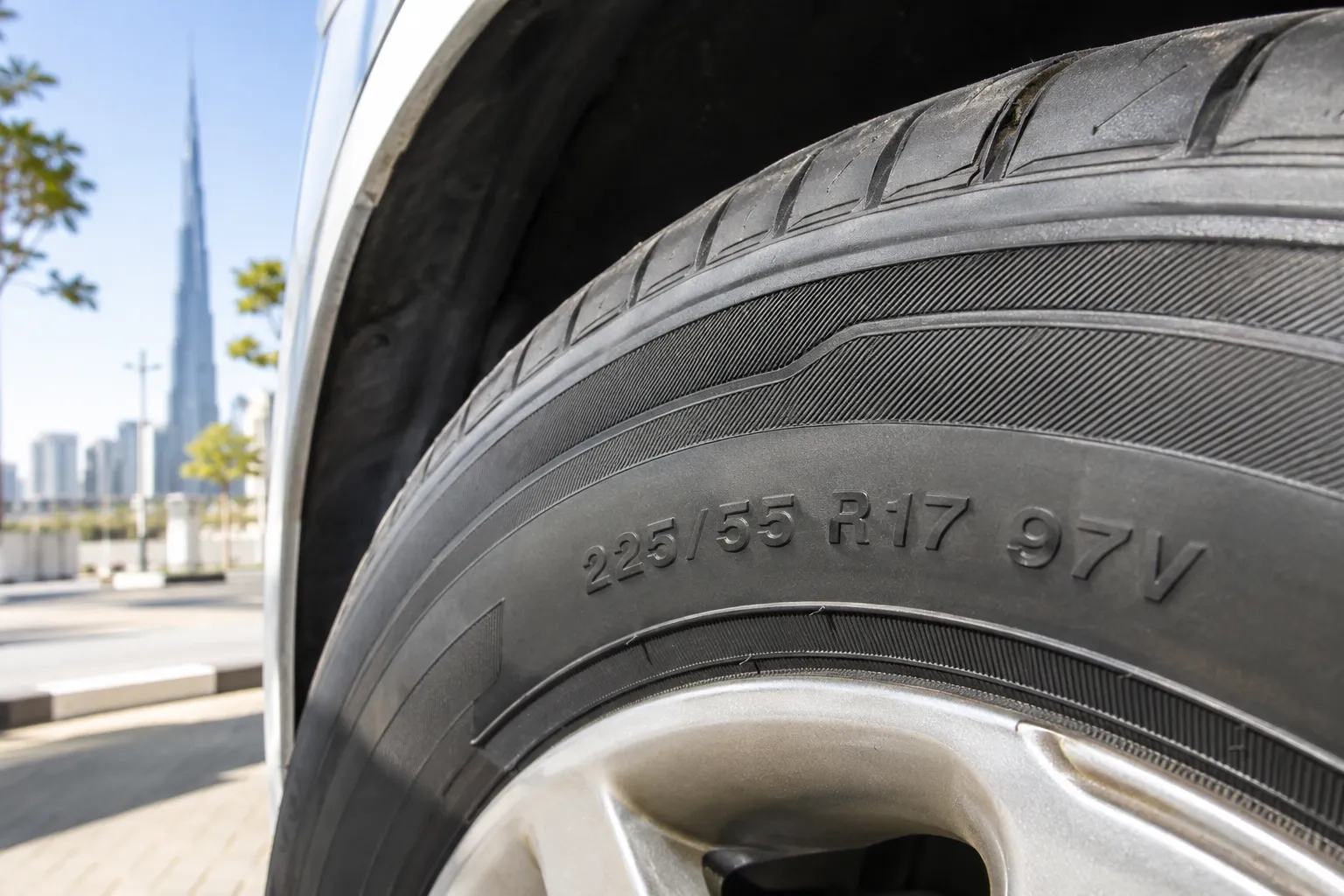
A tyre size such as 225/45 R17 94W tells you five things: the tyre is 225 mm wide, its sidewall height is 45% of that width, it has radial construction, it fits a 17-inch rim, and it can carry 670 kg at speeds up to 270 km/h. Every part matters when you replace a tyre, and the last two are the ones people most often get wrong.
This guide takes the code apart piece by piece, shows where your car maker prints the approved size, and lists exactly what to send us so we can quote the right tyre the first time.
What does 225/45 R17 94W mean?
| Part | In 225/45 R17 94W | What it means |
|---|---|---|
| Section width | 225 | Width of the tyre from sidewall to sidewall, in millimetres, when fitted to its measuring rim. |
| Aspect ratio (profile) | 45 | Sidewall height as a percentage of the width: 45% of 225 mm is about 101 mm. |
| Construction | R | Radial: the body cords run across the tyre at about 90° to the direction of travel. Almost every car tyre sold today is radial. |
| Rim diameter | 17 | The wheel diameter the tyre fits, in inches. It must match your rim exactly. |
| Load index | 94 | A code for the maximum load per tyre: 94 means 670 kg. |
| Speed rating | W | The maximum speed the tyre can sustain at its rated load: W means 270 km/h. |
The width is in millimetres but the rim is in inches. That mix is a historical quirk, and it is why you cannot work out a tyre’s height from the code without a little arithmetic. A 225/45 R17 is about 634 mm tall overall: 17 inches of rim (431.8 mm) plus two sidewalls of about 101 mm each.
Width and aspect ratio: why two tyres with the same rim look so different
A wider tyre puts more rubber on the road, which usually helps dry grip and steering response. It also takes more effort to roll and can hum more on coarse asphalt. The aspect ratio decides how tall the sidewall is: a 45-profile tyre feels sharper but rides harder over speed bumps, while a 65-profile tyre soaks up rough service roads and sharp kerbs far better.
Low profiles are the ones we see damaged most often in Dubai. A 35- or 40-profile tyre on a 19-inch wheel leaves very little rubber between the rim and a pothole or a basement-ramp lip, which is how pothole and kerb impact damage starts. If your car came with a choice of wheel sizes, the taller-sidewall option is the more forgiving one for daily UAE driving.
Load index and speed rating: the part people skip
The two characters after the rim size are not decoration. The load index is a code for how much weight one tyre can carry, and the speed rating is the top speed it can sustain while carrying that weight. Tyre makers advise never fitting a lower load index or speed rating than your car maker specifies. A higher one is fine.
| Load index | Max load per tyre | Speed rating | Max speed |
|---|---|---|---|
| 89 | 580 kg | T | 190 km/h |
| 91 | 615 kg | H | 210 km/h |
| 94 | 670 kg | V | 240 km/h |
| 96 | 710 kg | W | 270 km/h |
| 98 | 750 kg | Y | 300 km/h |
| 100 | 800 kg | (Y) | Above 300 km/h |
XL (extra load) or RF (reinforced) after the size means the tyre carries a higher load index at a higher pressure. SUVs and many European cars specify XL tyres, and if your placard lists them, the replacement must be XL too.
The rest of the sidewall: DOT code, run-flat marks and wear bars
The DOT code ends in four digits that give the week and year the tyre was made. That date matters in the UAE because tyre age, not tread depth, is what fails many cars at inspection. Our guide on how long tyres last in the UAE explains the five-year rule.
Look also for run-flat markings (RFT, ROF, SSR, ZP, DSST, depending on the brand) and a star or MO, AO or N0 mark, which shows the tyre was approved for a specific car maker. Run-flats should only be replaced with run-flat tyres unless the car maker says otherwise.
Where to find the size your car is approved for
The tyres on your car today are not always the right ones. A previous owner or a quick roadside job may have fitted something else. The approved size is printed in three places:
- The tyre placard on the driver’s door frame (B-pillar). Some cars put it inside the fuel flap or the glovebox lid.
- The owner’s handbook, usually in the specifications or wheels-and-tyres section, which often lists every size approved for each trim.
- The vehicle registration or dealer service records, if the car was ordered with optional wheels.
What to send us before we quote
- A clear photo of the sidewall showing the full size, load index and speed rating.
- A second photo of the DOT code if you want us to check the age of the other tyres.
- Your car’s make, model and year, and the trim if you know it.
- Whether you have run-flats or a TPMS warning light on.
- Where the car is parked, so we can confirm a mobile visit or suggest a workshop.
With those details we can confirm stock in the exact size and rating, show you options across value, mid-range and premium tyre brands and book the fitting. If you are not sure which tyres suit your car, our pages on tyres by vehicle type and tyre prices in the UAE are a good place to start.
Send us a sidewall photo and we will confirm the size and quote the tyre.
Questions drivers ask
What does the R in a tyre size mean?
R stands for radial construction, where the body cords run across the tyre at roughly a right angle to the direction of travel. It is not the rim size or a rating. Almost every car tyre sold in the UAE is radial.
Can I fit a tyre with a different load index?
You can fit a higher load index than your car maker specifies, but never a lower one. A lower index means the tyre is not built for your car’s axle loads. Check the placard on the door frame for the minimum.
Is 225/45 R17 the same as 225/45 ZR17?
Yes, the dimensions are identical. The Z is an older way of marking a tyre rated above 240 km/h. The load index and speed letter that follow the size are what tell you the actual rating.
Can I fit a wider tyre on the same rim?
Sometimes. Each rim width accepts a range of tyre widths, but a wider tyre changes the diameter unless you also change the profile. It can rub on the suspension or the wheel arch. Only fit sizes your car maker or a tyre professional has confirmed for your wheel.
Where is the tyre size on my car?
The tyre size is moulded into the sidewall of each tyre. The size your car is approved for is on the placard on the driver’s door frame and in the handbook. Check both, because the tyres fitted now may not be the original size.