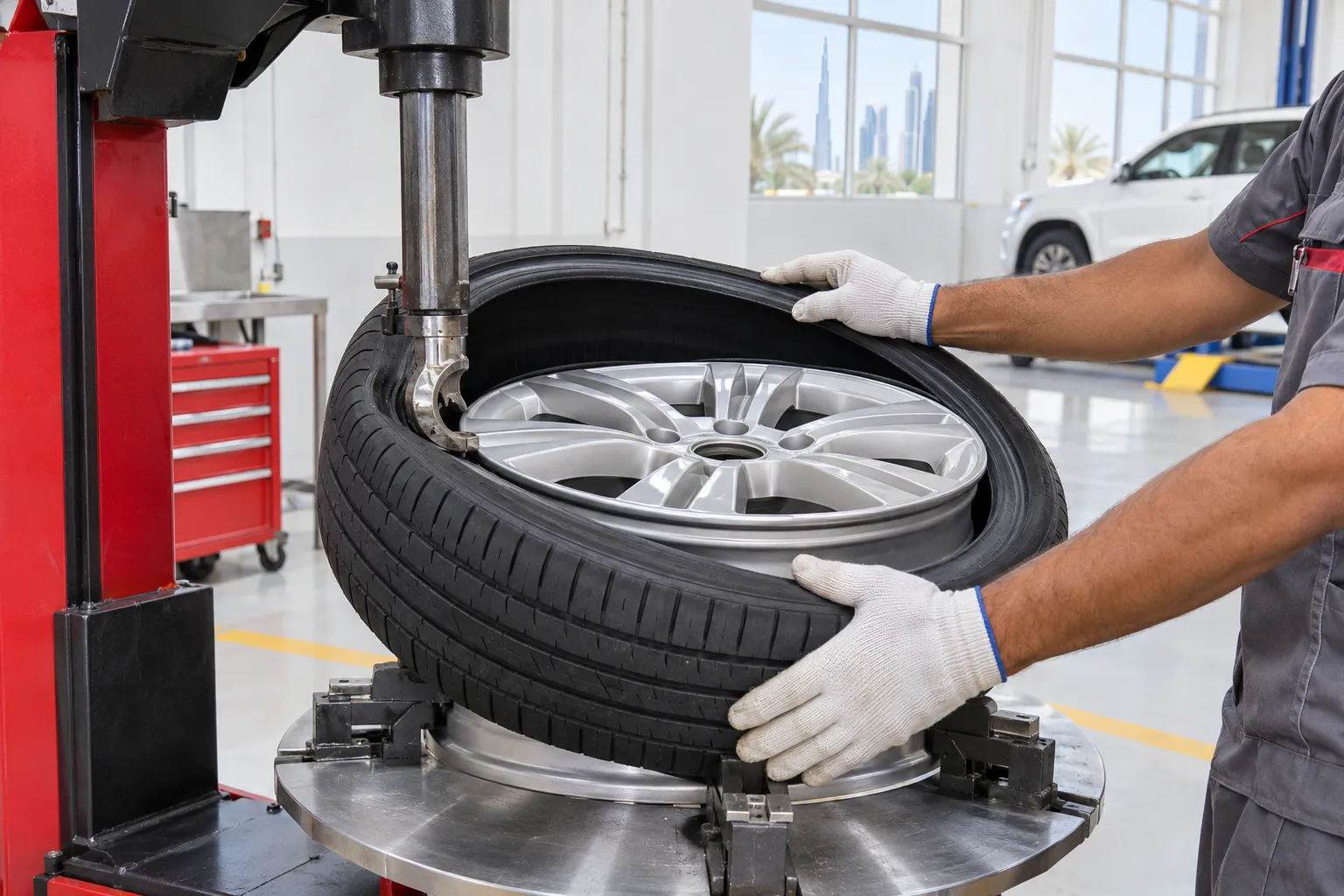
If you are replacing only two tyres, fit the new pair on the rear axle. That is Michelin’s guidance for front-, rear- and all-wheel-drive cars alike, because grip at the rear is what keeps the car stable. With worn tyres at the back, the rear can lose grip first on a wet or sandy bend, and the car spins (oversteer). With the better tyres at the back, the front slides first (understeer), which most drivers can recover by easing off.
Most drivers expect the opposite, especially with a front-wheel-drive car where the front tyres wear faster. Here is the reasoning, and the cases where the rule does not apply.
Why the rear axle needs the better tyres
Think of a sudden swerve on a motorway with sand blown across the lane. If the front tyres lose grip, the car runs wide but keeps pointing roughly where you were heading. Lifting off the accelerator usually brings the grip back. If the rear tyres lose grip, the back of the car swings round, and few drivers can catch that at speed.
Michelin’s own skid-pan demonstrations show this clearly. With new tyres on the front and part-worn tyres on the rear, the car was far more likely to spin in a wet bend. Its experts note that front-, rear- and four-wheel-drive cars respond in a similar way at the limit of grip, which is why the advice does not change with the drive layout.
New tyres on the rear
- Front slides first (understeer)
- Easier to control
- Tyre makers’ recommended fitting
New tyres on the front
- Rear can slide first (oversteer)
- Car may spin on a wet or sandy bend
- Feels sharper in normal driving, which is misleading
Does the UAE climate change the rule?
Rain is rare here, which leads some people to think the rule is for colder countries. But the first rain after a long dry spell brings oil and dust to the surface and makes roads unusually slippery, and blown sand on the highway does something similar. The rule matters most in exactly the rare moments you are least prepared for.
When the rule does not apply
- Staggered sizes: many sports cars, coupes and some luxury saloons have wider tyres on the rear. Those tyres cannot swap axles, so you replace the pair that is worn.
- All four replaced: the question disappears. See should you replace all four tyres.
- Directional or asymmetric tyres: these still go on the rear as a pair, but they must be fitted the right way round.
- A professional sees a reason not to: Michelin’s Middle East guidance allows a tyre professional to recommend otherwise for a specific vehicle.
For staggered cars, see coupe and sports car tyres.
What we do when we fit a new pair
- Check the remaining two tyresWe measure their tread and read their DOT date, so you know whether they have life left.
- Move the better pair to the rearIf the new pair is going on a front-wheel-drive car, the old rear tyres usually move to the front.
- Balance and set pressuresEvery fitted tyre is balanced, and pressures are set to the placard.
- Advise on rotationRotating at regular intervals keeps the set even. See when to rotate your tyres.
One more thing worth knowing: a car with fresh tyres on the rear and part-worn ones on the front can feel slightly less sharp on turn-in than before. That is the understeer bias doing its job. If the steering feels vague or the car pulls, have the alignment checked rather than swapping the tyres back, because a new pair often reveals a fault the old tyres were hiding.
Need a new pair fitted? Send your tyre size or a photo of the sidewall.
Questions drivers ask
Should new tyres go on the front or back of a front-wheel-drive car?
On the back. Even on a front-wheel-drive car, tyre makers recommend the better pair on the rear axle for stability. The worn rear tyres can move to the front if they are still legal and in good condition.
Why are new tyres put on the rear?
Grip at the rear keeps the car stable in a bend or swerve. With worn rear tyres, the back can slide first and the car can spin, which is much harder to control than the front running wide.
What if my car has different tyre sizes front and rear?
With staggered sizes the tyres cannot swap axles. Replace whichever pair is worn, and keep the same model on each axle.
Is it better to replace all four tyres?
Replacing all four removes the question and is often required on AWD cars with a big tread difference. On a two-wheel-drive car, a matching pair on the rear is a safe and common choice.