The most common reason a steering wheel shakes at motorway speed is an out-of-balance front wheel. Tyre makers including Continental and Bridgestone list it as the classic cause, and the shake typically appears in a speed band and fades above it. If the shake only happens when you brake, look at the brake discs. If it happens at all speeds or came on after a pothole or kerb, suspect a bent rim, a damaged tyre or worn steering parts.
When a driver tells me “it shakes at 110 but not at 140”, I already know where the balancing weights are going. Here is how to read the symptoms yourself.
Match the shake to the likely cause
| When you feel it | Most likely cause | Next step |
|---|---|---|
| In a speed band, often around 90–120 km/h, through the steering | Front wheel out of balance | Wheel balancing |
| Through the seat and floor rather than the wheel | Rear wheel out of balance | Balance all four |
| Only when braking | Warped or unevenly worn brake discs | Brake inspection |
| All the time, getting worse, after hitting a kerb or pothole | Bent rim or a tyre with internal damage | Rim and tyre inspection |
| With the car pulling to one side | Alignment, a tyre fault, or worn suspension | Alignment check |
BFGoodrich makes the same split: imbalance you feel through the steering wheel is usually at the front, while imbalance you feel in the seat is usually at the rear.
Wheel balance: the usual suspect
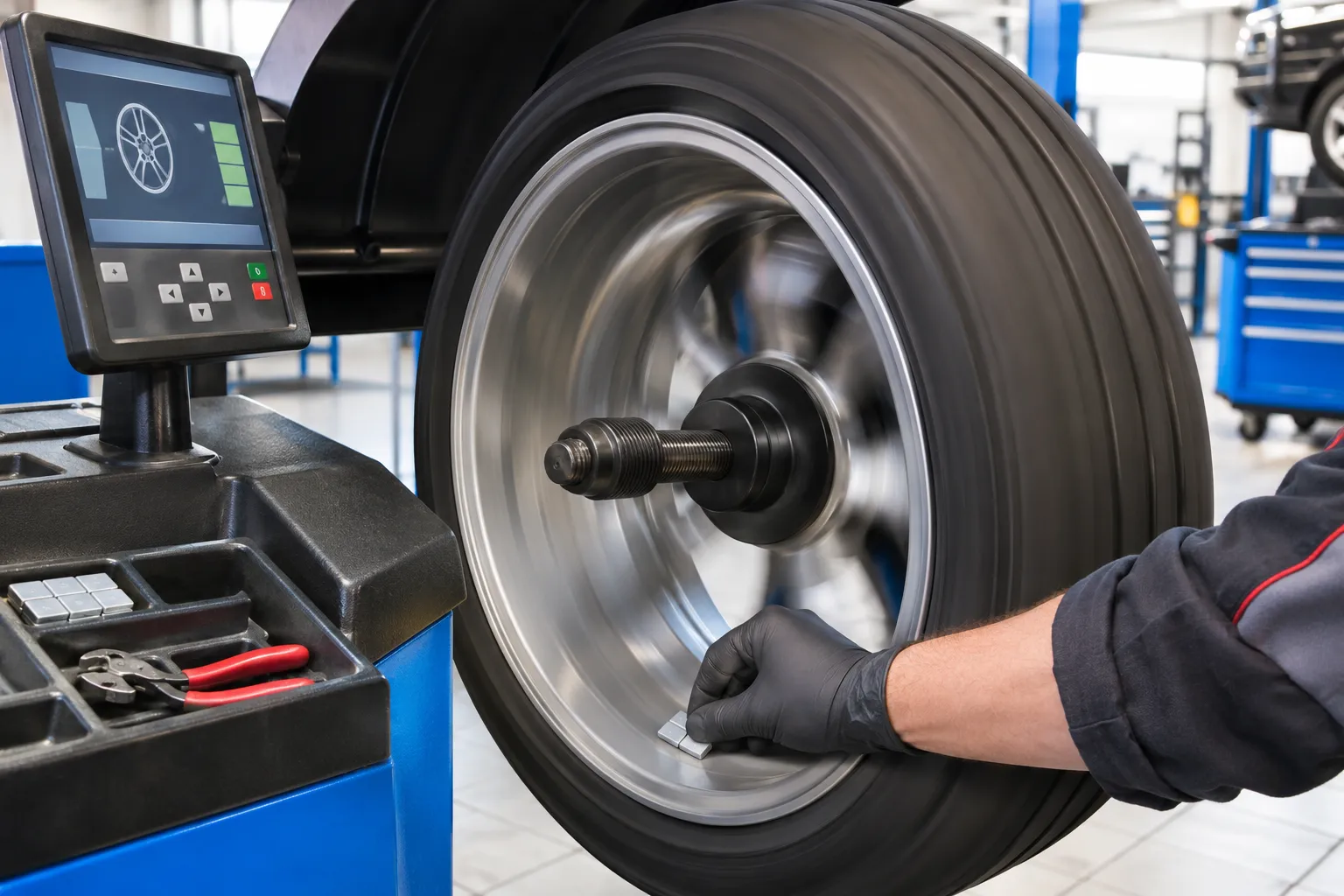
No wheel and tyre is perfectly even in weight. Balancing spins the wheel on a machine and adds small weights to cancel out the heavy spot. Those weights can fall off, tyres wear unevenly, and a repaired or new tyre changes the balance completely. Goodyear recommends rebalancing whenever you notice vibration, rotate the tyres, or fit or repair a tyre.
In the UAE, sand and mud build up inside the wheel barrel, especially after a desert drive, and can throw the balance off too. Wash the inside of the wheels before deciding they need balancing. Our wheel balancing service uses a van-mounted balancer, so it can be done at home.
Balance and alignment are not the same job
Wheel balancing
- Fixes vibration
- Corrects weight around each wheel
- Done with a balancing machine, mobile or in the workshop
Wheel alignment
- Fixes pulling and uneven tyre wear
- Corrects suspension angles
- Needs a level alignment rig in the workshop
Continental is clear that alignment deals with tracking and wear, not vibration. If your car pulls to one side as well as shaking, you probably need both. Our page on signs your alignment is out lists the pulling and wear symptoms.
When it is the rim or the tyre itself
Speed bumps taken too fast, basement ramps and kerbs can bend the inner lip of an alloy wheel without leaving a mark on the outside. A bent rim will not balance properly however many weights go on. Tyres can also develop a bulge or a separated belt inside, which makes a rhythmic thump that gets worse with speed. That is a safety issue, not a comfort one: see tyre bulges.
Bent rims can often be straightened at the workshop. Our rim repair page explains when straightening is safe and when a cracked rim has to be replaced.
Steering shaking at speed? Tell us when it starts and send a photo of each front tyre.
Can you keep driving with a shaking steering wheel?
A mild balance vibration is not an immediate danger, but it wears tyres, wheel bearings and steering parts faster, and it tires you on a long drive. A shake that is new, strong, getting worse or came after an impact should be checked before your next highway trip, because it can mean tyre or rim damage.
Questions drivers ask
Why does my steering wheel shake at 100–120 km/h?
This is the classic sign of an out-of-balance front wheel. The vibration often appears in a speed band and eases above it. Balancing the front wheels usually fixes it.
Does wheel alignment fix a shaking steering wheel?
Usually not. Alignment fixes pulling and uneven tyre wear. Vibration is normally a balance, rim, tyre or brake issue.
Why does my steering wheel shake when I brake?
A shake that only appears under braking usually points to uneven or warped brake discs, not the tyres. Have the brakes inspected.
Can a bad tyre make the steering wheel shake?
Yes. A tyre with a bulge, a separated belt or uneven wear can vibrate even when the wheel is balanced. Look for bulges and irregular tread, and stop using a tyre with a bulge.
How often should wheels be balanced?
Rebalance whenever a tyre is fitted or repaired, when you rotate the tyres, and whenever you notice vibration. Pirelli suggests not going more than about two years between balances.