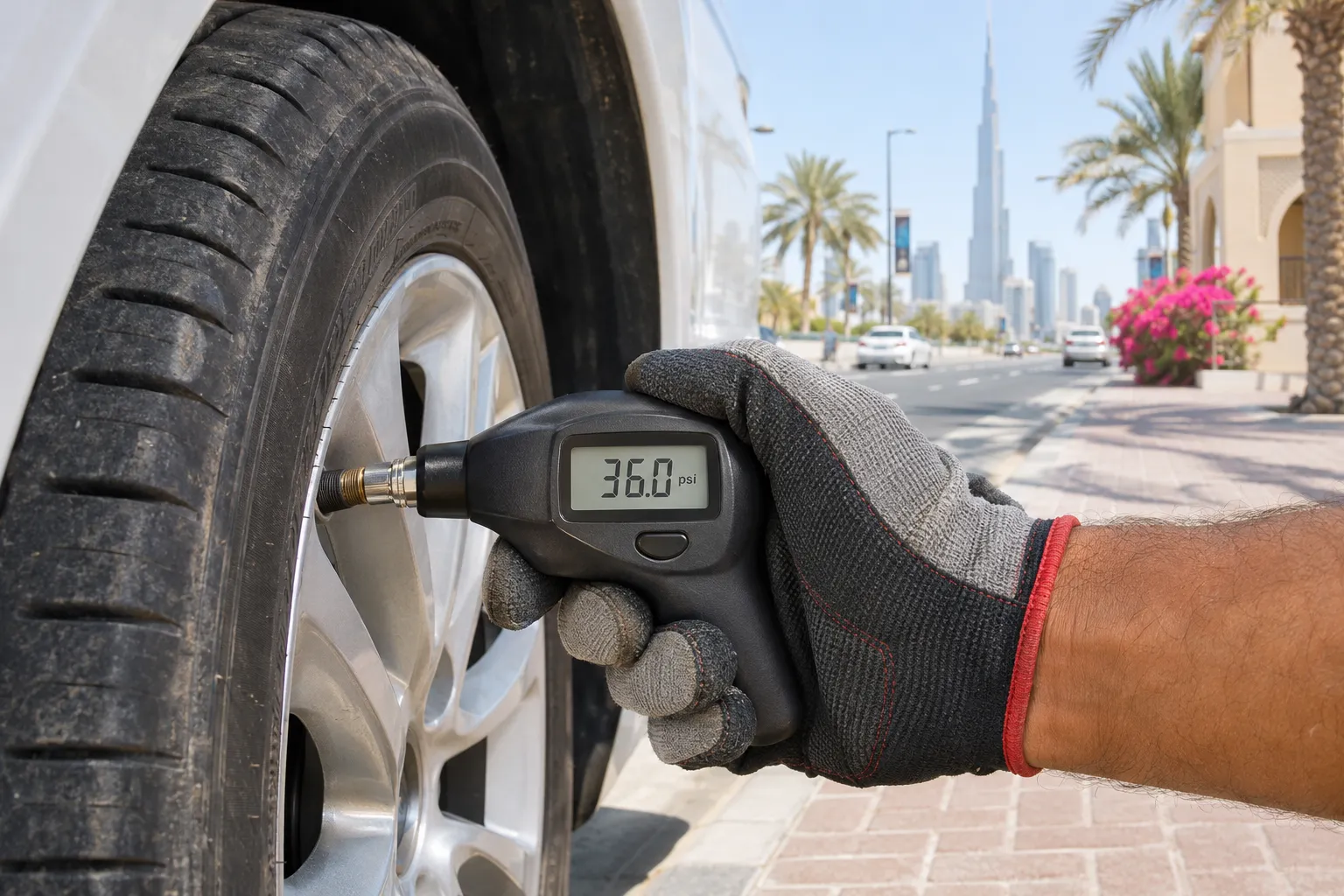
Check tyre pressure when the tyres are cold, meaning the car has been parked for at least three hours or driven less than a couple of kilometres, and set it to the figure on your door placard. In the UAE that usually means checking early in the morning, because a tyre that has sat in afternoon sun or just come off the highway reads several psi higher than its true cold pressure.
Getting this right matters more here than in cooler countries. Under-inflated tyres flex more, run hotter and are behind many of the summer blowouts we attend.
Step by step at the petrol station
- Find your number firstOpen the driver's door and read the placard on the door frame (some cars put it in the fuel flap or the handbook). Note front and rear figures and any "full load" figure. Our tyre pressure guide shows how to read it.
- Drive as little as possibleUse the nearest station, ideally first thing in the morning. A short drive warms the tyres slightly; that is acceptable, a 20-minute highway run is not.
- Remove the valve cap and press the gauge on firmlyA hiss means the seal is not seated. Read the gauge, then add or release air in short bursts.
- Do all four, then the spareSpares lose air quietly for months. A flat spare is no help on the hard shoulder.
- Refit the capsCaps keep sand and grit out of the valve core, which is a common cause of slow leaks.
Why you should not let air out of hot tyres
Pressure rises as a tyre heats up; that is normal and the tyre is designed for it. If you check after a long drive and see 4–5 psi above the placard, do not let air out. Once the tyre cools it will drop back, and you will be under-inflated.
Petrol station gauges: how much to trust them
Forecourt machines are handy but can read a few psi out, and some are left in the sun all day. A small digital gauge kept in the glovebox costs little and gives you a consistent reading. Use the machine for air, and your own gauge to check.
If one tyre keeps dropping more than the others between checks, you probably have a slow puncture or a valve leak. See punctures and slow leaks, or book a puncture repair.
Questions drivers ask
How often should I check tyre pressure in the UAE?
At least once a month and before every long drive. Tyres naturally lose a little air over time, and big temperature swings between summer and winter change the reading too.
Should I add more air in summer?
No. Set the cold placard pressure all year round. If you check in the cold morning and set the placard figure, the tyre will rise to a safe operating pressure as it warms up.
What PSI should my car tyres be?
Use the figure on your vehicle's placard, usually on the driver's door frame. Most sedans fall roughly between 30 and 36 psi, but your car's figure is the only correct one.
Does my TPMS replace manual checks?
No. TPMS warns you after a significant pressure drop, not when a tyre is a few psi low. Manual checks catch slow losses earlier. See TPMS sensor service if the warning light comes on.